Best First Aid Kits for Families in 2026: 4 Practical Picks
Compare four practical first aid kits for families, including budget, premium, and portable options, plus the important supplies every ready-made kit may still need.
Quick Answer
The American Red Cross Deluxe 299-Piece Kit is our value pick among these four options. It is affordable, clearly organized, and covers many common minor injuries.
Choose the BAND-AID Brand All-Purpose Kit if you prefer familiar wound-care brands, the MyMedic MyFAK if you want a more durable premium setup, or the MyFAK Mini when portability matters most.
Jump to a section
A first aid kit is one of those household items you hope stays closed. When someone cuts a finger, twists an ankle, or wakes up with an insect bite, however, a well-organized kit can save time and reduce confusion.
The difficult part is choosing one. A box labeled “200 pieces” can sound comprehensive while containing mostly small adhesive bandages. A more expensive kit may be better organized, but it can also include trauma supplies that require training.
For this guide, we compared the published contents, organization, portability, intended use, and current availability of four ready-made kits. We have not personally tested these products, so the recommendations below are based on manufacturer specifications and practical household needs—not invented hands-on experience.
Our Four Practical Picks
| Kit | Best for | Main strength | Main drawback |
|---|---|---|---|
| American Red Cross Deluxe 299-Piece | Most families | Broad everyday coverage at a reasonable price | The large piece count includes many bandages |
| BAND-AID Brand All-Purpose | Familiar wound-care products | Useful name-brand basics in a hard case | Less room for larger supplies |
| MyMedic MyFAK | Premium organization | Durable case with space to customize | Expensive and comparatively bulky |
| MyMedic MyFAK Mini | Cars and grab-and-go bags | Compact and easy to carry | Too small to be the only kit for many households |
1. American Red Cross Deluxe 299-Piece Kit — Best Overall Value
This is the easiest recommendation for a typical household. The soft nylon case weighs about 1.3 pounds and uses clear pockets, so you can see supplies without emptying everything onto the floor.
The published contents include several sizes of adhesive bandages, sterile gauze pads, a gauze roll, a trauma pad, antiseptic wipes, antibiotic ointment, gloves, scissors, tweezers, a cold compress, an emergency blanket, and a first aid guide. It also includes small quantities of common over-the-counter medications.
What we like:
- Good balance of wound-care supplies and useful accessories.
- Clear interior pockets make it easier to locate an item quickly.
- Soft case works well in a cabinet, vehicle, or emergency bag.
- Reasonable starting price compared with premium kits.
What to know: The 299-piece number is not the same as 299 different tools. A substantial part of the count consists of adhesive bandages and wipes. The kit also contains only one pair of nitrile gloves, so adding several more pairs would be sensible.
Best for: Families wanting one practical, affordable kit for everyday home injuries and emergency supplies.
2. BAND-AID Brand All-Purpose Kit — Best Familiar-Brand Option
This compact hard-case kit focuses on familiar everyday products. Its listed contents include assorted BAND-AID Brand adhesive bandages, cleansing wipes, gauze pads, rolled gauze, paper tape, NEOSPORIN antibiotic cream, BENADRYL anti-itch cream, TYLENOL caplets, and a non-medicated cold pack.
That mix makes sense for ordinary cuts, scrapes, minor burns, itching, and aches. The rigid case also helps keep small packets from becoming crushed inside a crowded cupboard or car trunk.
What we like:
- Recognizable wound-care and medication brands.
- Hard case keeps the contents together and is easy to wipe clean.
- Compact enough for apartments, dorm rooms, cars, and travel.
- Straightforward contents without many survival gadgets.
What to know: This remains a basic household kit. Families may want to add more gloves, larger gauze dressings, a better pair of scissors, and any personal medications they rely on. Always check medication labels, allergies, age restrictions, and expiration dates.
Best for: Households that want a simple, recognizable wound-care kit rather than a tactical-style bag.
3. MyMedic MyFAK — Best Premium Organized Kit
The MyFAK is built for people who care about organization and durability as much as the supply count. The case uses a folding-page layout, has extra room for customization, and includes mounting straps. At roughly 11 by 8 by 6 inches and 3 to 4 pounds, it is substantial enough to serve as a central household or vehicle kit.
MyMedic offers Standard and Pro versions. The Pro version adds serious-bleeding supplies, including a choice of tourniquet. Those additions can be valuable, but equipment is not a substitute for learning how and when to use it.
What we like:
- Better organization than most inexpensive kits.
- Durable case with room to add personal supplies.
- Suitable for a home, camper, or regularly used vehicle.
- Training is included with the current product offering.
What to know: The MyFAK costs much more than a standard household kit and takes up more space. The Pro version is not automatically the right choice for every family. If you buy equipment for severe bleeding, take a recognized first aid or bleeding-control course.
Best for: Families willing to pay more for a durable, organized kit they can customize over time.
4. MyMedic MyFAK Mini — Best Compact Kit
A large home kit is useful only when you can reach it. The MyFAK Mini offers a smaller option at about 9 by 6 by 5 inches and 2 to 2.7 pounds, depending on configuration. Measure your bag or vehicle compartment before buying; it will not fit every glove compartment. The manufacturer currently lists 92 supplies for the Pro version, so compare the exact configuration rather than assuming every Mini has the same contents.
This is the option for families that already have a main kit and want a second, portable layer of coverage. It can also work for one person or a couple who have very limited storage space.
What we like:
- Easy to move between a car, backpack, and home.
- Organized more carefully than many inexpensive mini kits.
- Available in Standard and Pro configurations.
- Useful as a companion to a larger household kit.
What to know: Compactness requires compromise. It does not provide the depth of supplies many families would want during a longer emergency or when several people need care. Treat it as a portable companion, not automatically as your household’s only kit.
Best for: Cars, day trips, emergency bags, and families adding a portable second kit.
How We Compared These Kits
We did not rank the products by piece count alone. Instead, we looked at five practical questions:
- Does it cover common household injuries? A useful kit needs cleaning supplies, dressings, gauze, tape, gloves, and basic tools—not simply dozens of identical bandages.
- Can you find things quickly? Clear pockets, labeled sections, and sensible grouping matter when someone is hurt.
- Can the kit be carried? A heavy case may work at home but become inconvenient in a vehicle or evacuation bag.
- Can it be refilled? Supplies get used and medications expire. A reusable case with accessible compartments is more practical over time.
- Is its intended use realistic? A compact car kit and a central family kit solve different problems.
What Every Ready-Made Kit May Still Need
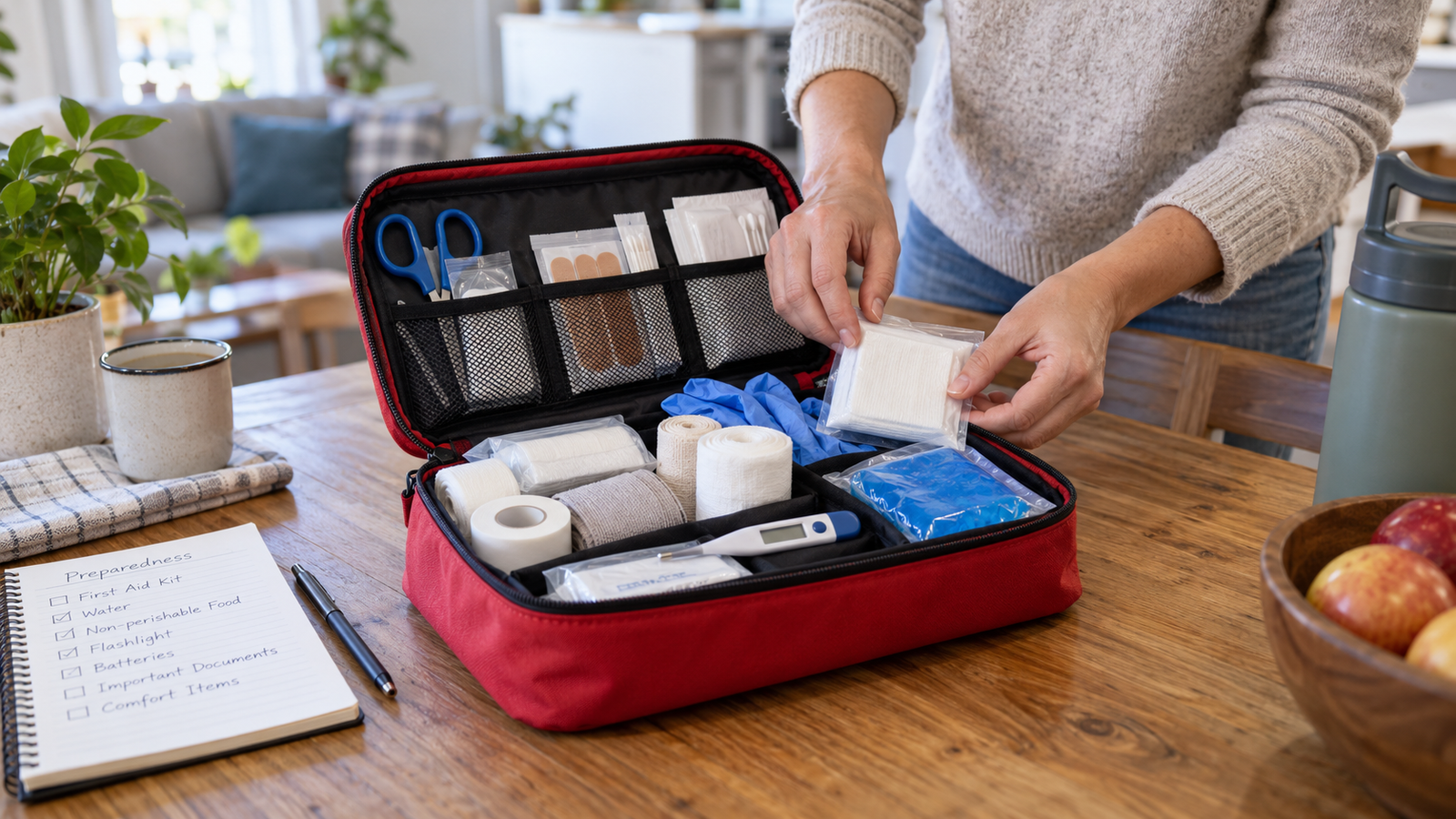
Even the best first aid kit for families will need some personalization. Before buying anything, review our home first aid kit checklist. It explains the basic categories to inspect and helps you identify what a packaged kit leaves out.
Depending on your household, useful additions may include:
- Several extra pairs of nitrile gloves in appropriate sizes.
- Additional sterile gauze and a larger roll of medical tape.
- A digital thermometer.
- Emergency contact information and important medical details.
- Doctor-recommended medicines and supplies for allergies or chronic conditions.
- Child-appropriate items selected with guidance from a healthcare professional.
- A small flashlight and spare batteries stored beside the kit.
Keep medicines in their original packaging, read every label, and store the kit where responsible adults can reach it but young children cannot. Review the contents at least twice a year and replace opened, damaged, or expired items.
For a vehicle kit, check every medicine’s labeled storage temperature. A parked car can become too hot or cold for medicines even when the bag itself is durable; ask your pharmacist how to store essential medicines safely.
Do You Need a Trauma Kit?
For most households, a broad first aid kit is the sensible starting point. Trauma supplies are meant for severe injuries and require more knowledge than an ordinary adhesive bandage. Owning a tourniquet without understanding its correct use can create false confidence.
If serious-bleeding preparedness is important to you, purchase reputable equipment and take an in-person first aid or bleeding-control course. Call emergency services for severe bleeding, breathing problems, loss of consciousness, suspected poisoning, major burns, or any condition that appears life-threatening.
Our Verdict
For most families, the American Red Cross Deluxe 299-Piece Kit offers the best combination of price, organization, and everyday supplies. The BAND-AID Brand All-Purpose Kit is a straightforward alternative for familiar basics.
The MyMedic MyFAK makes more sense when durability, organization, and customization justify a higher price. The MyFAK Mini is the portable choice, particularly as a second kit for a car or emergency bag.
Whichever one you choose, open it before an emergency. Learn where everything is, add the supplies your family actually needs, and put a reminder on the calendar to check it regularly. A modest kit you understand is more useful than an impressive kit nobody has examined.
Product prices, contents, and availability can change. Check the manufacturer’s current listing before purchasing. This guide provides general preparedness information and is not a substitute for professional medical advice or certified first aid training.