How Much Emergency Water Should You Store? A Practical Guide for Families
Learn how much emergency water your family should store for 3 days, 1 week, or 2 weeks, plus practical tips for safe storage and backup water.
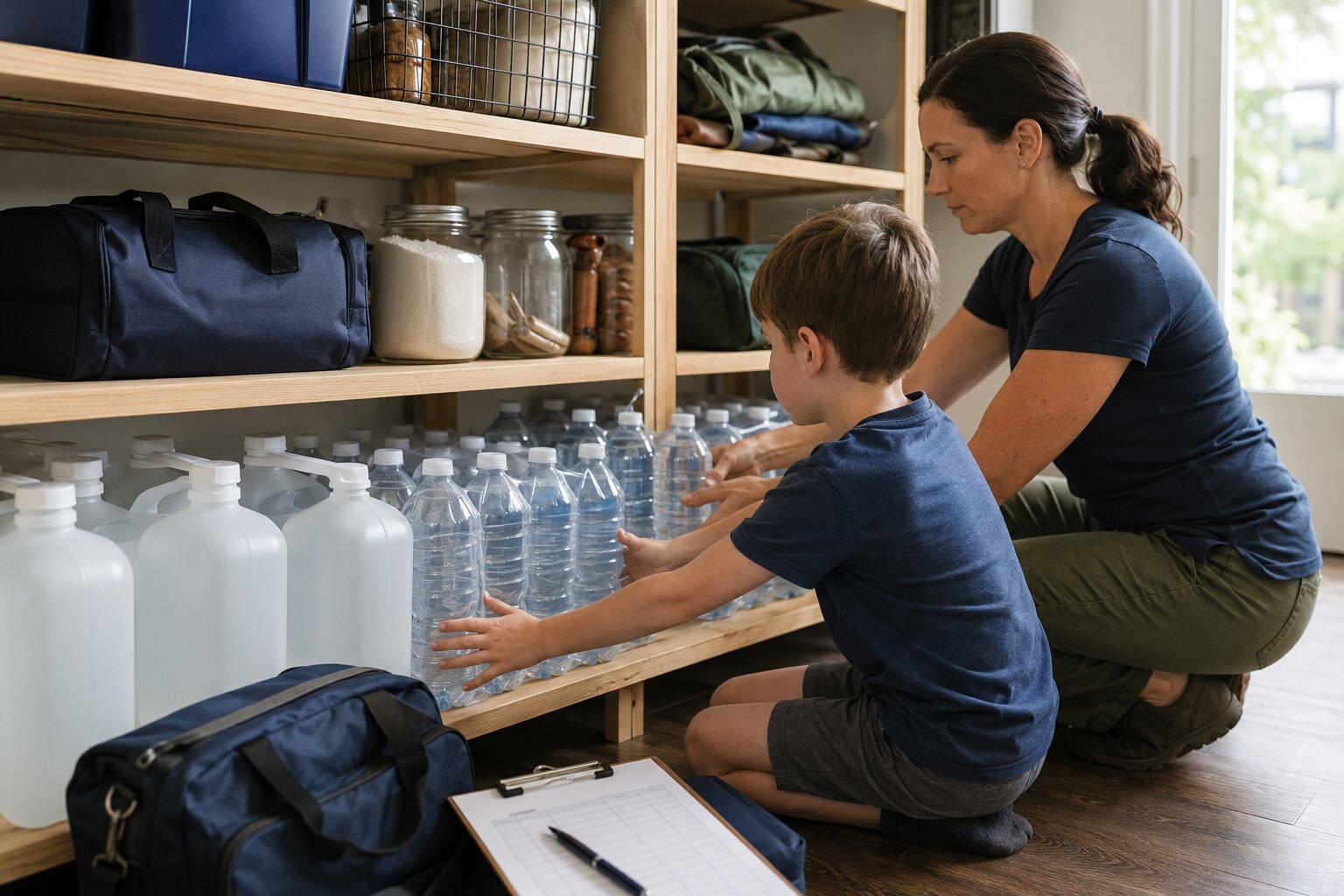
The Short Answer
Store at least 1 gallon (about 3.8 liters) of water per person per day for at least 3 days.
If space and budget allow, work toward a 2-week supply. Store extra for hot weather, pregnancy, illness, pets, and anyone with additional medical or hygiene needs.
Jump to a section
Build your household plan: Use our emergency water supply calculator for totals in US gallons and liters, pet and extra allowances, and a printable storage checklist.
Water is easy to take for granted until the tap stops running. A blackout can shut down a well pump, a storm can damage local pipes, and flooding can make tap water unsafe. Even a short interruption becomes frustrating when a household needs water for drinking, cooking, brushing teeth, and basic hygiene.
Building a backup supply is simpler than it sounds. Start with a few cases of bottled water, work out what your household needs for three days, and add to it gradually. You do not need to buy a two-week supply in one expensive trip.
How Much Emergency Water Should You Store?
The standard starting point is simple:
Number of people × number of days × 1 US gallon = minimum water supply
That gallon is intended to cover drinking and basic daily needs such as limited food preparation, brushing teeth, and essential hygiene. It is a minimum planning amount, not a promise that every household will use exactly the same quantity.
| Household size | 3 days | 7 days | 14 days |
|---|---|---|---|
| 1 person | 3 gallons | 7 gallons | 14 gallons |
| 2 people | 6 gallons | 14 gallons | 28 gallons |
| 4 people | 12 gallons | 28 gallons | 56 gallons |
| 5 people | 15 gallons | 35 gallons | 70 gallons |
For a family of four, that works out to at least 12 gallons for 72 hours and 56 gallons for two weeks. Fifty-six gallons can sound overwhelming—and it is heavy—so treat it as a long-term target. Secure the first three days, then build from there.
When Should You Store More?
One gallon per person per day is a useful baseline, but your household may need more. Increase your emergency water supply when:
- You live in a hot climate or expect extreme heat.
- Someone is pregnant, sick, elderly, or has additional medical needs.
- You have babies or young children who require formula preparation or more frequent cleaning.
- You have pets.
- Your meals require water for cooking.
- Your home depends on an electric well pump.
- You want extra water for cleaning wounds or essential hygiene.
Pets need their own supply. Their needs vary by size, diet, activity, temperature, and health, so ask your veterinarian if you are unsure how much to plan for.
Start With a 72-Hour Water Supply
Three days is the most useful first milestone. It costs less, takes up less room than a two-week reserve, and still gives the household breathing space during a short outage or local emergency.
Commercially bottled water is an easy starting point. The CDC describes unopened commercial bottled water as the safest and most reliable emergency source. Keep it in its original sealed container and follow the manufacturer’s storage and expiration guidance.
If you are building the rest of your household supplies at the same time, use our guide to the best emergency kits for families in 2026 as a practical starting point. Water should be stored alongside—not replaced by—the other essentials in your kit.
Build Toward One Week, Then Two
Once your 3-day supply is ready, increase it gradually. Add one case or container during a normal shopping trip. A simple progression looks like this:
- First goal: 3 days for every person and pet.
- Second goal: 7 days.
- Longer-term goal: 14 days when space and budget allow.
Do not let the two-week target stop you from starting. A complete three-day supply sitting safely at home is more useful than a perfect shopping list that never gets purchased.
Bottled Water or Refillable Containers?
Commercially Bottled Water
Bottled water is convenient, sealed, and easy to rotate into normal household use. Smaller bottles are portable and make it easier to distribute water between family members. The tradeoff is that many small bottles use more storage space and create more packaging.
Water Stored at Home
If you fill containers yourself, use containers designed for food or drinking-water storage. They should have tight-fitting lids and be made from durable material that will not break easily. Follow the container manufacturer’s cleaning and storage instructions.
Do not use containers that previously held toxic chemicals, fuel, pesticides, or other unsafe substances. A container that looks clean can still retain dangerous residue.
Important Rotation Reminder
Follow the printed date and manufacturer’s instructions for commercial bottled water. When you fill clean storage containers yourself, the CDC recommends replacing the water every 6 months.
Compare capacities and filled weights in our emergency water-storage container guide. For refillable containers, use the CDC container-cleaning and sanitizing instructions before filling.
Water Gets Heavy Fast
One gallon of water weighs roughly 8.3 pounds, or about 3.8 kilograms. A 5-gallon container therefore weighs more than 40 pounds before counting the container itself.
Large tanks use space efficiently, but a full one may be impossible for one person to move. Most families are better served by mixing a few container sizes:
- Small bottles for drinking and evacuation.
- Medium containers that adults can carry safely.
- Larger stationary containers for home use.
Do not store your entire supply in one container. If it leaks, becomes contaminated, or cannot be moved, you could lose access to all your water at once.
Where Should You Store Emergency Water?
Store water in a cool location away from direct sunlight. Keep it separate from gasoline, pesticides, cleaning chemicals, and other toxic substances. Avoid places where containers are likely to freeze, overheat, fall, or be damaged.
Spread the supply across a few sensible locations if possible. You might keep the main reserve in a cool indoor storage area, smaller bottles in the family emergency kit, and a limited portable supply near your evacuation bags.
Make sure every adult in the household knows where the water is stored and which containers are safe for drinking.
Short on space? Our guide to storing emergency water in a small apartment explains how to measure storage spots and divide your reserve into manageable containers.
Do You Also Need a Water Filter?
Stored water should be your first layer because it is immediately available and does not depend on finding another water source. A filter or treatment method can be a useful backup, but it is not a reason to skip stored water.
Different filters remove different contaminants. Some may reduce bacteria or parasites but not viruses, chemicals, fuel, salt, or radioactive material. Water contaminated with fuel or toxic chemicals cannot be made safe simply by boiling or ordinary disinfection.
Follow official local instructions during an emergency. If authorities issue a boil-water or do-not-drink notice, use the method and water source they recommend.
Our guide to making water safe in an emergency explains boiling, disinfectants, and the limits of filters. Save the official instructions before a disruption.
A Practical Family Water Plan
15-Minute Water Check
- Count the people in your household and list pets separately.
- Multiply the number of people by 3 US gallons for a three-day minimum. Add a separate supply for each pet and extra water for household needs.
- Check how much safe water you already have.
- Choose a cool, accessible storage location.
- Write the purchase or refill date on your calendar.
- Add one extra container during future shopping trips until you reach your longer-term goal.
During a power outage, reliable information can be as important as supplies. A battery-powered or hand-crank radio can help your family receive official local updates when internet or mobile service is unreliable. See our guide to the best emergency radios for power outages in 2026.
Common Emergency Water Mistakes
- Storing water for adults but forgetting children and pets.
- Keeping the entire supply in containers that are too heavy to move.
- Using containers that previously held unsafe substances.
- Storing water beside fuel, pesticides, or household chemicals.
- Depending only on a filter without storing ready-to-use water.
- Forgetting to check dates and rotate self-filled water.
- Assuming clear water is always safe to drink.
Frequently Asked Questions
Is one gallon per person per day enough?
It is the recommended minimum starting point for drinking and basic daily needs. Your family may need more because of heat, illness, pregnancy, pets, medical needs, food preparation, or hygiene.
How much water does a family of four need for 3 days?
Using the minimum guideline, a family of four needs 12 gallons for 3 days. Add separate water for pets and any additional household needs.
How much water does a family of four need for 2 weeks?
A 14-day minimum supply for four people is 56 gallons. Build toward that amount gradually if storing it all at once is difficult.
How often should stored water be replaced?
For commercially bottled water, follow the printed date and manufacturer’s guidance. For water placed into clean storage containers at home, the CDC recommends replacing it every 6 months.
Can I rely on a bathtub full of water?
Do not make an open bathtub your primary drinking-water supply. It can be useful for flushing toilets or other non-drinking purposes, but stored bottled water or water kept in suitable closed containers is a safer plan for drinking.
Final Thoughts
A two-week water reserve does not have to appear overnight. Begin with enough for 72 hours, store it properly, and add to it when space and budget allow.
The best plan is the one your household can maintain: water for every person and pet, containers people can safely handle, dates that are easy to track, and a backup treatment method for a longer disruption.
Start with three days. That is a useful supply today—and a solid base for whatever you add later.